CULTUREEscaping the Life Underneath: Reading Remarkably Bright Creatures
At a time when I was trying to avoid grief, Shelby Van Pelt's novel helped me see my dad’s life in a new light.
Somehow, for the last four years, I was blindly unaware of the cultural phenomenon that is Shelby Van Pelt’s bestselling novel, Remarkably Bright Creatures. (An especially egregious error for someone who worked in publishing for so long.)
It was April, and I was looking for a distraction. For me, this time of year is bittersweet. Southern California hits peak beauty; its blue skies beckon us to step out and enjoy the sun’s return, while sparing us from the impending summer heat. And yet, I often stay in. April reminds me of the anniversary of my dad’s passing, who died this month in 2021 at the age of 74, from cancer. I resent the cheery weather outside for not matching my mood, while inside, I’m looking for an escape.
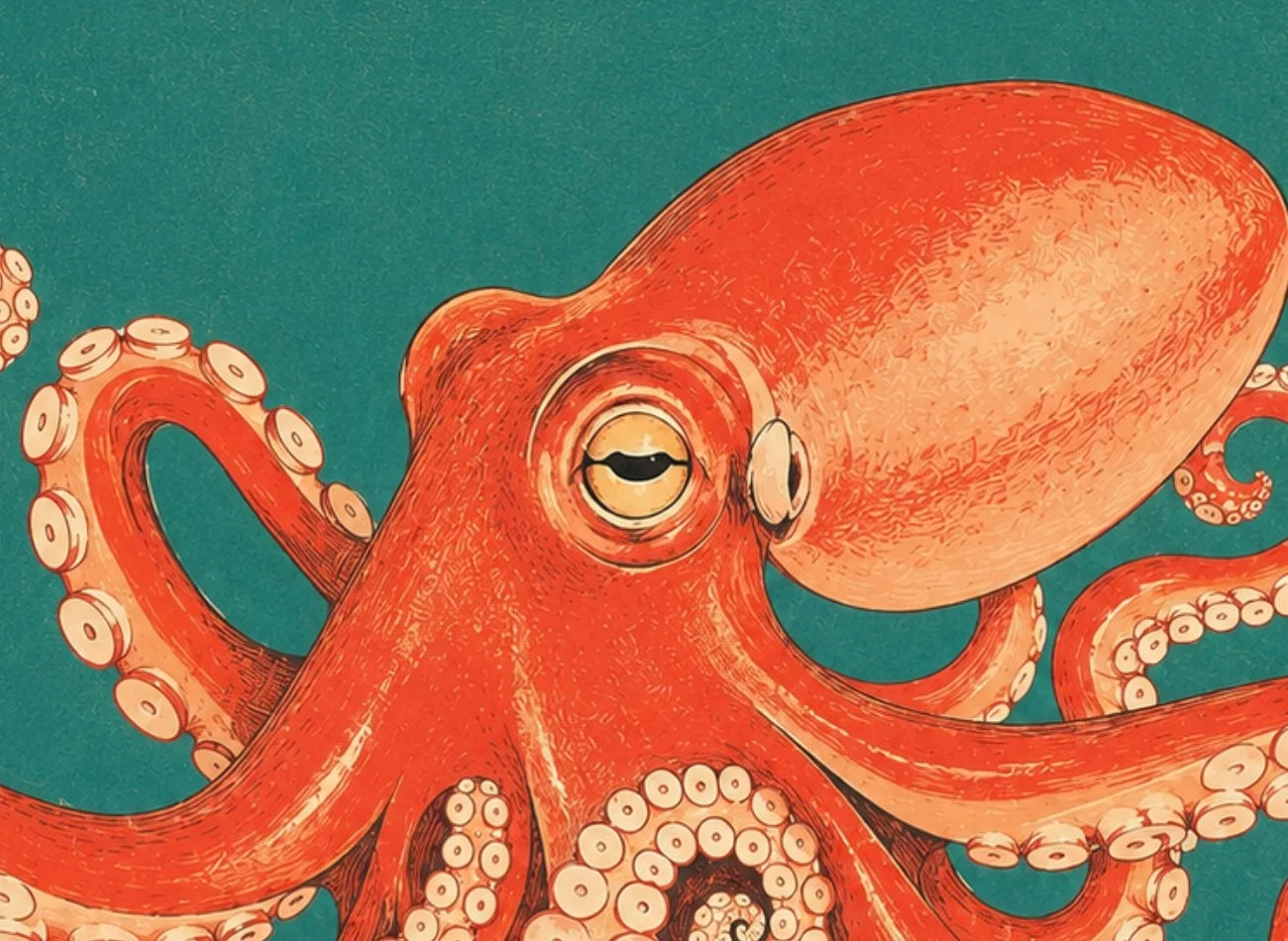
So when a neighbor recommended a charming story about an octopus, I was in. Yes, technically, in chapter one, we meet a very charming octopus. Move to chapter two, however, and the story takes a quick turn.
Grief, family, and aging — these topics come on quick once you meet Tova, the novel’s central character, who is 70. We don’t often get novels with a septuagenarian lead. Main characters are always middle-aged, which is apparently where literature thinks our problems peak. But Tova is older, and her life is still so full of questions. Her son mysteriously drowned in the Puget Sound when he was a teenager. Cancer took her husband, and early in the novel, her older brother dies too. She’s gratefully surrounded by friends who love her, yet they also have families—children and grandchildren—whom they gossip about and fret over and make their world full, while Tova’s world grows smaller.
Clearly, this was the exact kind of story I was hoping to avoid.
For most of my dad’s life, he searched for answers about his roots. His mother abandoned him as a baby, and part of him wanted to know the reason. So he escaped into work. Growing up, I watched him work constantly. As his kid who often starved for his attention, it frustrated me. But looking back, I realize it gave him a channel to put all the questions he could not answer.
Like my dad, Tova works. Alone each night, she cleans the town’s aquarium with the obsession of an artist. To her, the job matters. It gives her purpose. The vast sea was her son’s grave, so she maintains this tiny, enclosed piece of it as if it were his headstone. Eventually, this brings her into the orbit of Marcellus, a giant Pacific octopus nearing the end of his own life.
Marcellus is one of the book’s great characters. His chapters are the comic rewards for the novel’s moodier plot lines. He’s observant, funny, deeply intelligent, and more emotionally competent than most humans.
His friendship with Tova works because neither of them needs to explain much. (Not that he could, he’s an octopus after all.) They simply recognize something in each other. He, too, is mourning. Once he had the ocean, and now he has a tank. He spends his days surrounded by loud, slack-jawed tourists and sticky children pounding the walls of his cell. The loss of a free life out in the sea — and the realization he’ll never have it again — are things Tova understands.
And then a young man, Cameron, comes to town looking for answers about the mother who abandoned him and the father he never knew. Cameron, who is only 30, also feels old in his own way. Smart and musically talented, he spent his youth as the only member of an amateur rock band who took it seriously as a potential career, even at the expense of real relationships and real jobs with paychecks. Now at 30, he’s broke and too old to blame irresponsibility on his youth. With nothing left, he’s convinced that finding his history will fix him. What he finds instead is a job at an aquarium, training to become the successor to its cleaner with an eight-legged friend. And the three discover something together that changes them.
What I loved most was how easily the book reads without feeling shallow. Everyone is trying to move forward from a life that did not go the way it was supposed to. The themes are heavy, and the words have depth, but the prose flows, and it’s light to read. There is a cinematic quality to the storytelling that keeps you hooked. It’s literature that feels written for the world we live in now—my favorite kind of book.
As for my dad, in his late life, he finally found the family that had abandoned him, through a long-lost sibling. His biological mother and father were no longer alive, but they had multiple children—brothers and sisters he never knew—raised by them together in a home he never knew. Of all of them, he was the youngest. And the only one they gave away. If he ever learned why, he never shared it with me. Soon after this discovery, he retired and finally leaned into it. He took a vacation to Hawaii. He visited California. He helped me with a down payment on my first home. He spent time with my sister and his grandson. He was lighter.
Remarkably Bright Creatures asks what we do when life takes away the identity we thought we were owed. It questions the strange human belief that a fresh start means we can leave everything behind.
Maybe that is why the book stayed with me. It understands that no matter how old we are, we are still trying to become someone who can live with what came before. And sometimes that means finally turning around to look at what has been following us, instead of looking for an escape.
On a bright April Sunday, I finished the book. I felt motivated to embrace the cheery weather and drive to Carbon Beach. I watched the ocean for a while, undistracted, when an older gentleman seated behind me tapped my shoulder and pointed to a figure in my sightline I hadn’t seen. I snapped a video. A plump seal sat quietly on a rock, enjoying the sun’s return — a relief, no doubt, from the turbulent life underneath.

Words by
Adrian Palacios
Published
APRIL 22 2026EXPLORE MORE
The Meme Is the New Press Release
It all begins with an idea. Maybe you want to launch a business. Maybe you want to turn a hobby into something more.
When the AI Prompt Goes Wrong
AI can make your messages faster—but not always better. Here are four ways to use AI without losing the human in your communications.

Taking Copywriting From Meh to Mwah!
Two pit bulls, endless fur and one robot vacuum that reminded me good copy talks to people, not about products.